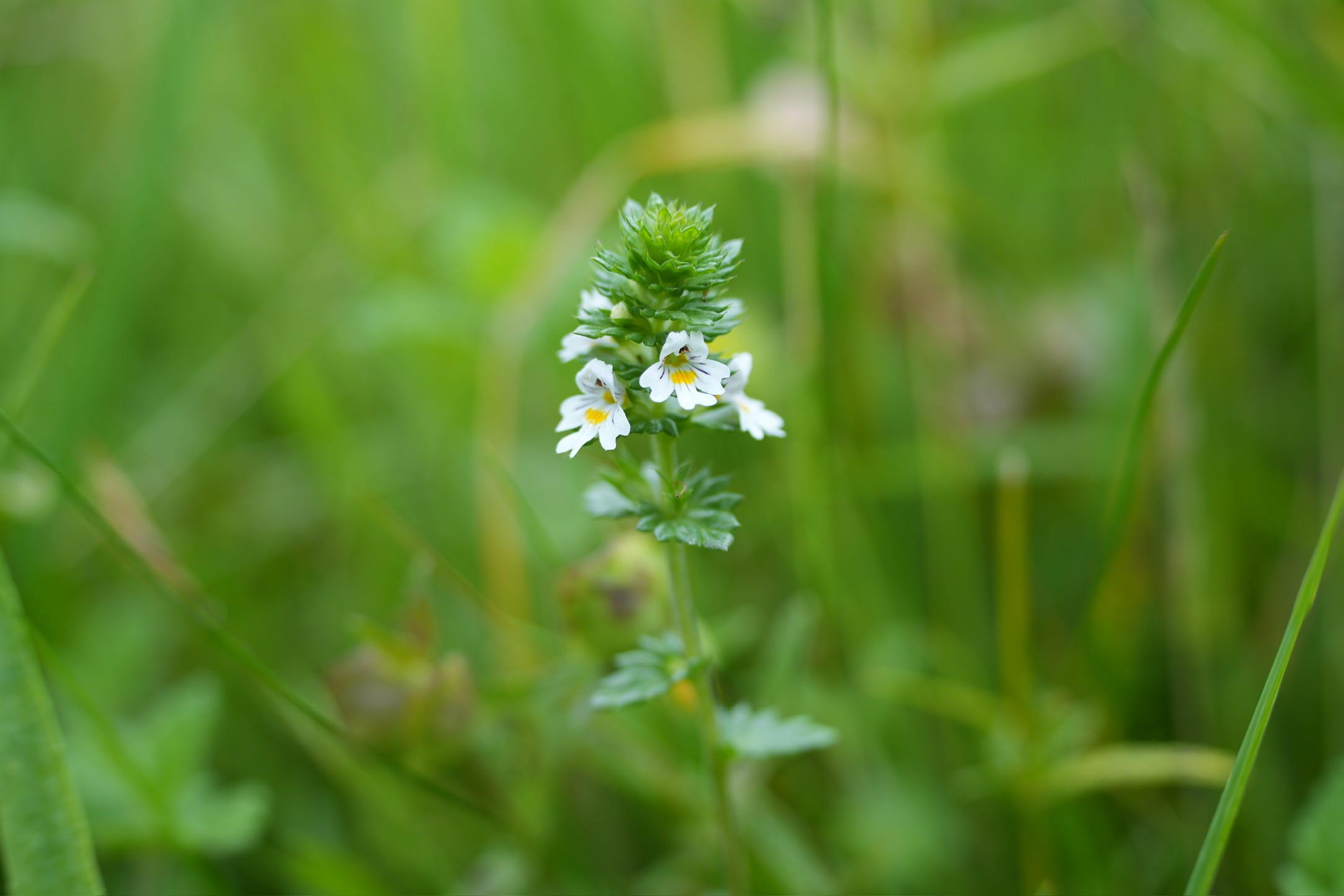
When we first moved to our garden in Yorkshire, I started noticing a tiny white-flowered plant in our meadow. At first I acknowledged it but thought little of it until I looked up and discovered it was eyebright (Euphrasia spp.) a hemiparasitic plant, it attaches its roots to other plants to extract nutrients from them. Hemi, which means half or partially, because it can still absorbs nutrients from soil and photosynthesises. The gardening world champions yellow rattle in meadows but eyebright is rarely mentioned. Yet as I’ve learnt, this tiny wonder is every bit key piece in the grassland puzzle.
Need to know information about Eyebright
Eyebrights are annuals that germinate in spring, flower in summer and then set seed, all within the growing season. There are 20 known species in the UK and a huge number of hybrids and subspecies. They all look incredibly similar making them very hard to identify without the help of an euphrasia expert, of which there aren’t many! Eyebrights cross breed and hybridise so readily, even with DNA analysis it sometimes isn’t clear. One of the best clues is location and conditions.
In this article I’ll refer to them by the genus Euphrasia, the genus being the category containing all species of eyebright. For my fellow botany nerds, the technical way to refer to a particular plant you’ve spotted when you know the genus but not the specific epithet, is to write “Euphrasia sp.” for one plant/species, or “Euphrasia spp.” to refer to multiple species within the genus. Anyway...
Alongside yellow rattle in the UK, eyebright is known as a meadow maker because of its parasitisation. This reduces the vigour of grasses, helping other wildflowers grow, though it parasitises wildflowers too.
Eyebright is considered a sign of good grassland because it encourages diversity of plants and therefore other wildlife. It’s a short plant, no more than 15 - 25cm at most, forming low and loose mats. This also means it doesn’t fare well in long swards because it needs the light of a low sward to grow well. Therefore it’s an indicator of good grassland because it can only get a foothold where the sward is already relatively open and low, at least in patches.
Personally I have only ever really seen it growing where the sward is low. I guess it is contributing to that by weakening the other plants around it, but it is also clearly very dependent on light.
How to grow eyebright

The good news is that, as long as eyebright have light and some soil contact with seeds, they’re easy enough to grow. Collect or buy local seed and sprinkle on bare or well-raked soil in a grassland - they actually grow really well in grazed pasture as well as cut meadows. It’s best to start your patch in an area of grass that you know is already low and open to ensure the seedlings receive enough light to get going.
Sow seed as happens in nature toward late summer. The plants flower from the base upwards producing seeds at the bottom while the top is still flowering. Little seed capsules appear where the flowers were at leaf nodes. Each capsule only produces 2-3 very small seeds. Sow immediately to let them overwinter outdoors.
At the Calderdale Plant Sanctuary, a new project to grow local wild plants, Gill Wrigley and the team grew starter plants of eyebright in pots by first germinating meadow grass seeds and then sowing the eyebright. This allowed the eyebright to parasitise the grass and grow strongly.
Are eyebright good for wildlife?
The most important role for Euphrasia spp. is arguably its part in diversifying grassland plant communities to offer more vegetation, pollen and nectar types for a wider range of insects.
That said, those tiny leaves and abundant low flowers are of course also useful in their own right. Pollinators will use the nectar and pollen, and leaf eaters will munch the tiny leaves.
Butterflies, moths, flies, hoverflies, bees, wasps and true bugs and beetles will all use the plants in one way or another.
In many ways, eyebright has come to be one of my favourite wildflowers because when you see it, you know you’ve found a good patch of grassland. It’s also very pretty.
Keep learning with a £26/year Wild Way paid subscription…
How to grow shrubs from summer softwood cuttings
Midsummer is an ideal time to take softwood cuttings from your favourite shrubs to grow more of these expensive plants for free. It’s easy, fun and very rewarding when you see your new plants growing happily. With slightly less to do in the garden at this time of the year, it’s a leisurely morning task.
Sambucus nigra | elderflower tree
The first tree I fell in love with for planting in other people’s gardens is elderflower, Sambucus nigra. I use it in almost all of my designs for its beautiful look, ease of growing, ruffled texture and wildlife value. While I used to have a real thing for the purple cultivars, and still do, it is the wild species that I’m increasingly drawn to. Its divided fresh green leaves, craggy bark, reliable imperfect shape. Plus the flat cream-white umbels in June are a highlight of the year for me, followed by glossy dark berries. It is one of my favourite plants to see and here I’m going to explain to you why.
Perennial vegetable plant community (Part Two)
Back in my Perennial vegetable planting plan lesson I shared a simple design for a globe artichoke and perennial kale led edible planting area. All planted in a small space easily recreated in small or urban gardens.
How to study moths in your garden
One of the hopes with my book A Greener Life was to change opinions on unfairly maligned wildlife including moths and hoverfly. These two groups of insect are completely harmless to humans, they don’t sting or bite. In fact, they are very gentle and cute creatures.


Very interesting. We started yellow rattle off in our community orchard last year (and have a scything routine and a newly trained scyther) and it’s going very well, the yellow rattle sowings have taken, flowered and we should get a good crop of seed to extend the plants further into the trees.
I’ve not come across Eyebright before (although the name does feel familiar) so I might suggest we get some of that started too. Thank you!