

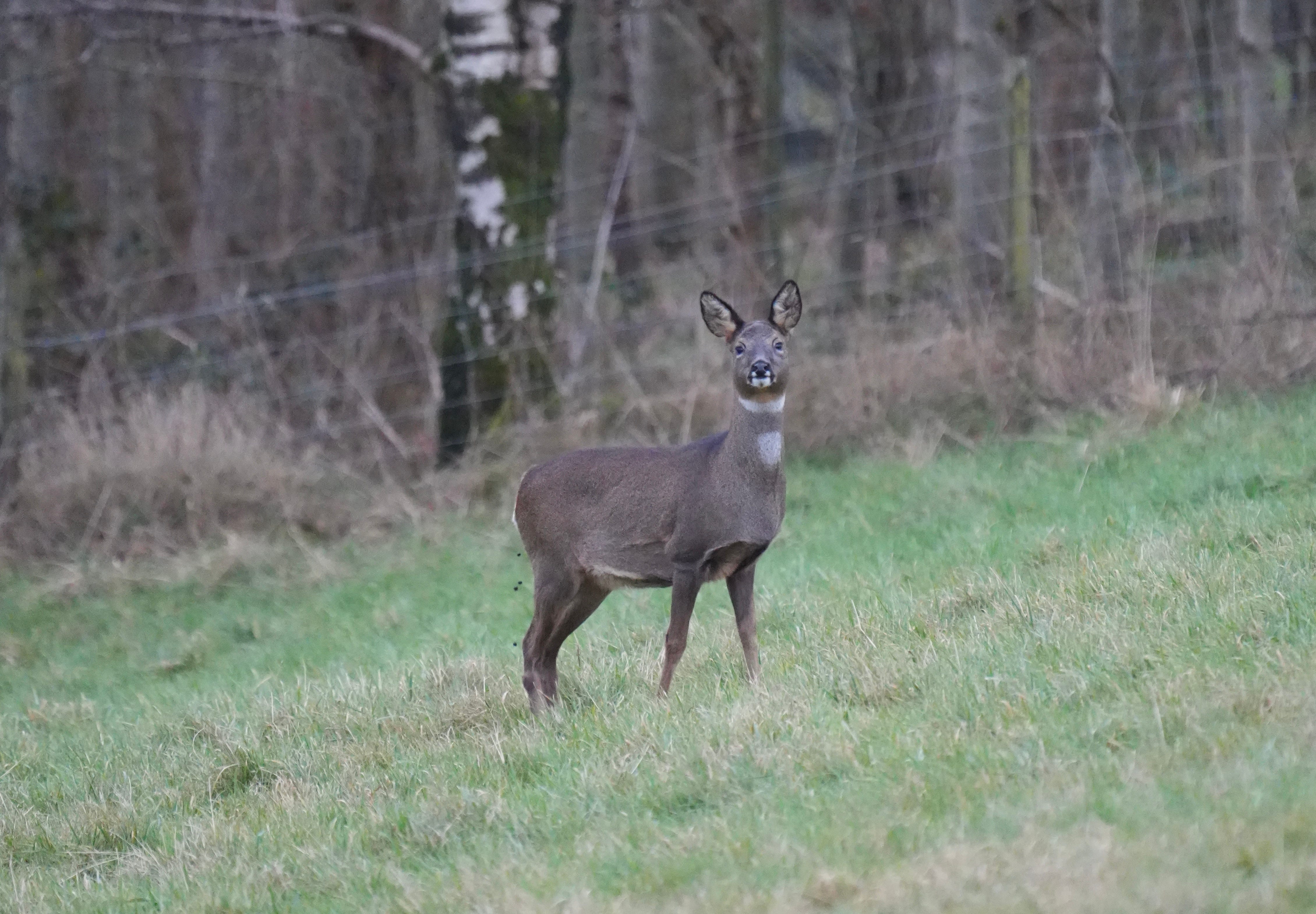
Walking down the slope of our farm carrying my heavy wildlife lens looking for birds and finding none, I chance my luck in the meadows. A robin sings somewhere close by, the distant call of a jackdaw in the light mist. Either will do, I love them all. A gull glides too far away in the sky. When ahead of me, in the grass at the far end of the field a movement and, after almost four years of sharing this place with them, I know who it is, the family of roe deer that call this hill home. Having a rest in the grass, which is dry for once.
I’d never expected to become an expert on roe deer but I can feel it slowly happening to me. Knowledge through osmosis of living in proximity of one another. I always try to avoid calling them our roe deer, that instinct of ownership is a human trait I dislike that doesn’t fit our true wild way. Instead, the roe deer are one of the hill’s magical entities, dancing in and out of nature’s veil. Always present, existing with us and yet always at a distance apart. Sometimes dependably there, other times vanished until ready to reveal themselves again. Like all wildlife, they live in another realm.
And there’s truth to that because, we’re guilty of imagining the world only as we experience it through our human senses, body and mind. Writer Ed Yong explains in his book An Immense World, this is called umwelt; how the world is experienced by a particular organism. Our human umwelt is led by our senses and sight is our strongest. Hard then to imagine how a roe deer, with its huge fluffy ears and big button nose experiences the world more by sound and scent as well as sight, able to hear or smell our approach from further away. That forcefield of distance is likely led more by their ears and nose than it is seeing us. I’ve noticed their ears aim in my direction long before they lift their head to look and sniff at me, deciding if I’m too close or not.
There are four ears directed at me in the grass, and the two European roe deer stand up alert, their distinctive white patch on the rears visible. One has a single antler, a male buck in the process of shedding them, as they do each winter. New antlers will already be growing beneath, downy like felt through winter, a layer rubbed off to reveal the wooden crown for rutting in spring. Roe deer antlers are quite small and vertical compared to other deer, though they do grow larger as the males age.
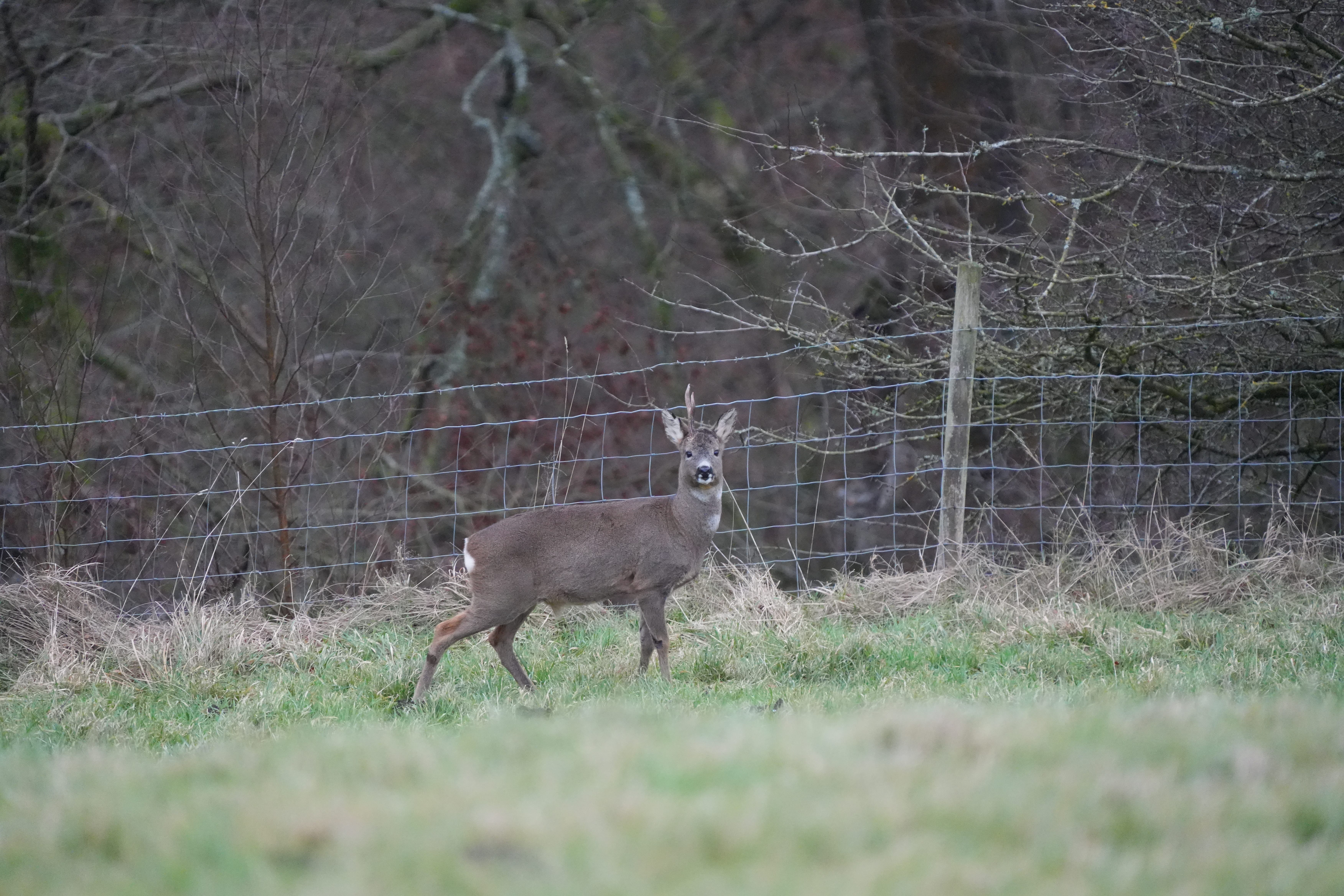
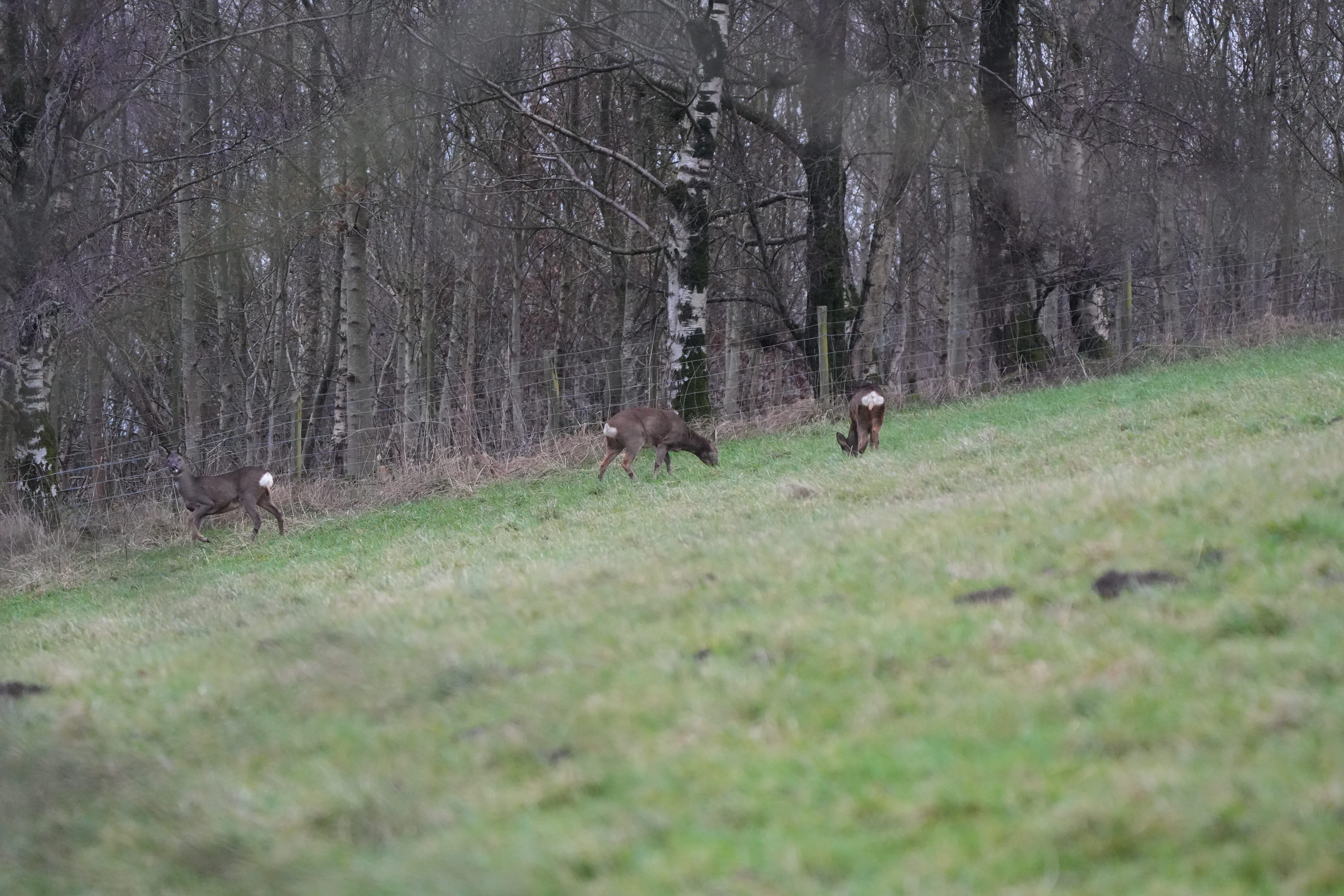
They see it’s me, the same human that stands watching them, saying ‘hello deer’, asking them to trust me, projecting that they’re safe here. And they know I’m far enough away, slowly walking the fence line maintaining their forcefield of distance. We walk in an opposing circle to one another. I don’t want to disturb them too much, I’ll only go so far before retreating to leave them to it. Then, I spot a third koala face on the other side of the field looking to the elders to decide what to do. Quite far away but I can tell it’s the younger of the three. Around our farm they are always in a group of three in winter. I suspect the female, their fawn from the summer now almost fully grown who will start their own journey next summer, and a buck. Occasionally there might be a second buck, slightly further out of the group’s orbit.
According to the Wildlife Trusts, roe deer mate and give birth in the summer, and bucks are said to be solitary, but I see them on their own as much as hanging out with females like this for months on end.
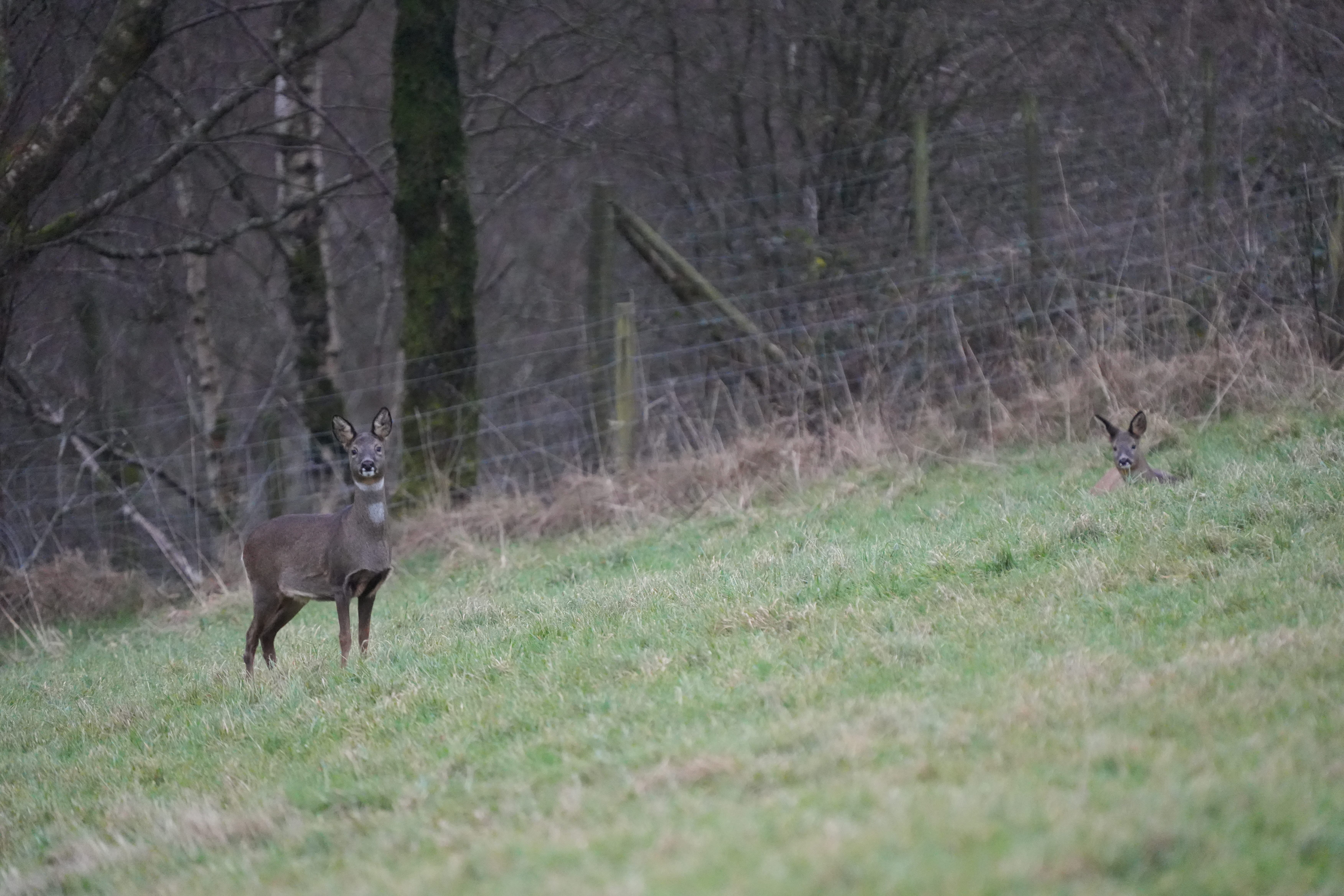
Logically I know the deer are likely to be different each year but their presence feels the same. A connection I feel when alongside all nature that’s so powerful, so built in to our humanity, everything else pales by comparison. And yet, that is lost to so many, or I hope, still buried deep within.
I’m reminded of our first summer on the farm, when walking through the meadow, I saw in front of me the classic white dots on rusty-brown fur of a newly born fawn. Breathing gently, not looking, to hide from my approach, I had stepped too far into their world. As quickly and quietly as possible I stepped away, not seeing their mother, on which they are dependent for milk for the first 2 - 3 months, knowing they would be watching me, with eyes, ears and nose.
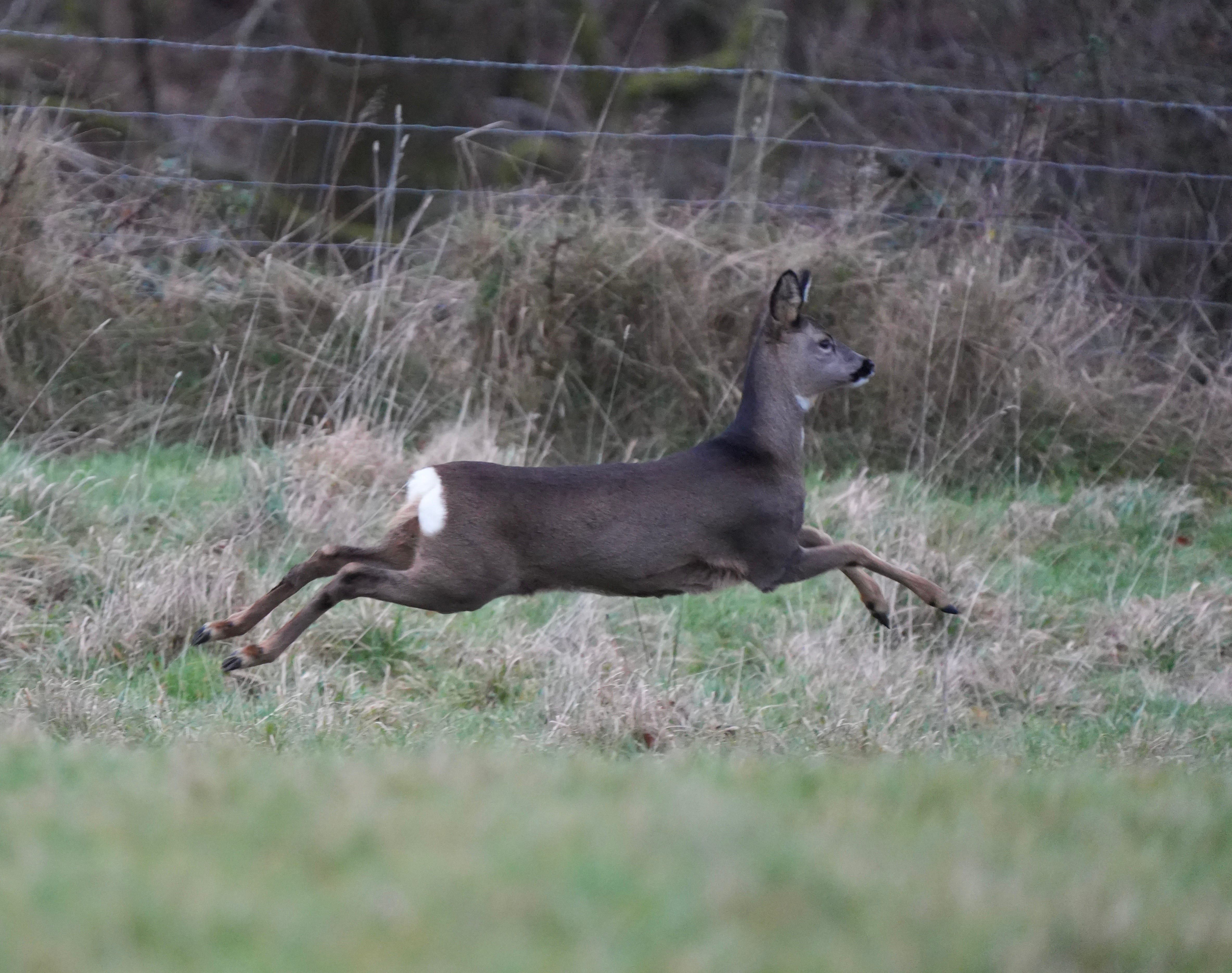
I love the roe deer on our farm, they are a challenge in our garden, and especially with our vegetables, but it’s easy to live alongside these gentle beings with the right choice of plants and an occasional barrier. All my life I’ve dreamt of growing up, of owning a garden and seeing a deer emerging out of the woods to step into it. I have to remind myself regularly, I’m no longer dreaming.
If you’d like to see roe deer or any deer, head to large woodland with meadows and grasslands nearby. You’re bound to spot some in the open around dawn and dusk, and increasingly, out in the daytime too. Roe deer are found all over the UK and are very common. In Calder Valley they can be spotted all over the place, if you go for a long walk, you are bound to see them.

Nice job, Jack. Our best holiday wishes go out to your family and you!
Phil Wilson
We live on a farm in Cornwall and the number of deer have certainly increased over the years - we have a few small pockets of woodland that they move between and I often see them in groups of 3 or 4. Even though they’re now a common sighting, it still makes me hold my breath and stand still for a while when I come across them…though they are always aware of me way before I’ve spotted them!! Aren’t we lucky x