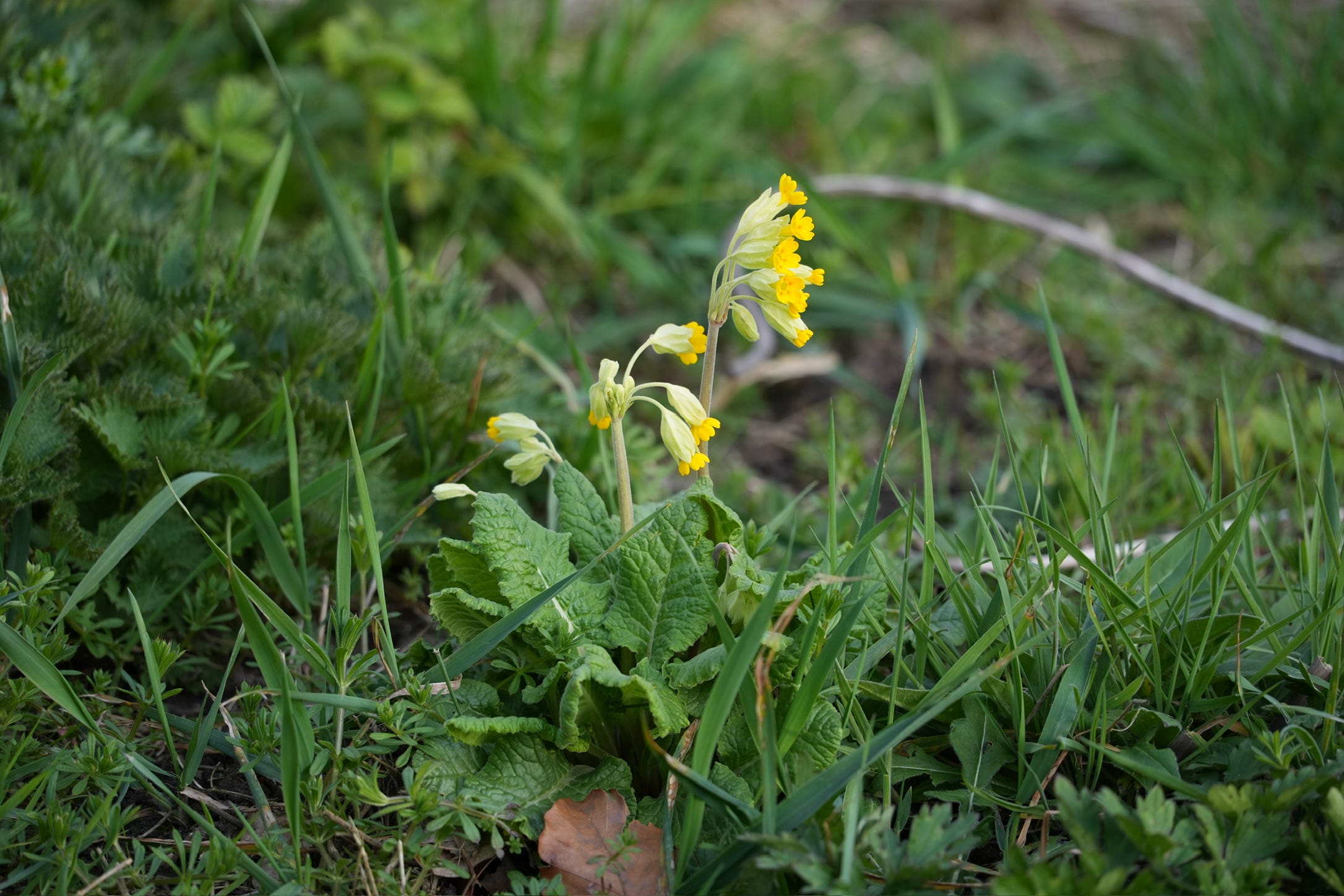
Cowslip is one of Europe’s common native plants that saw a big decline in the UK post-World War II due to habitat destruction from ploughing grassland. These days in Yorkshire I see it mainly on steep grassy banks lining A-roads toward the east and north of the county. It’s far more common in the south of the UK.
It took me a few years in our garden to discover a single cowslip in our coppice where it almost certainly was planted by a previous owner. I left it for a couple of years to tough it out but decided in autumn to hoik it up to a less competitive spot in our garden.
I’m glad I did. I was able to easily divide that one plant into three. A few months later each division has already grown to full size, happily flowering in different spots of our garden.
Using cowslip in design
I’m planning to encourage the spread of cowslip in two key areas:
Garden: as one of our key low-growing spring plants to form a light yellow wash through our main garden.
Wilder area: primarily filled with native wildflowers, here I’ll let it grow in among the grass of the mini-meadow and woodland edge.
In both areas it grows alongside primrose, Primula vulgaris, with which it can hybridise to form something that looks like a cross between the two, called Primula vulgaris x veris. Not to be confused with oxslip, Primula elatior, which looks similar but is a rarer species native to East Anglia.
Cowslip will grow happily in pots and windowboxes as long as they don’t dry out. In fact, they are perfect for this in part-shade spots where they will grow in the same pot for years and years.
Because cowslips are quite small, like primroses, they are great spring flowers when everything in the garden is low, adding a little bright pop of colour. They are tough plants as long as they don’t completely dry out for long periods of time - most of the UK is fine.
Able to tolerate a fair amount of shade, they’re well suited to growing in competitive wild plant communities as well as designed ones in gardens. Taller summer plants can grow over the top of them without affecting them - very useful!
Propagating cowslip
It’s super easy to grow more cowslip. Dig up and divide plants (not from the wild) by hand - as discussed above, they come apart into little pieces easily. I find their clumps, like primroses, are actually dense patches of closely growing separate plants. They will also self sow if you have a number of plants - they are not self-fertile and need partner plants, which is why our single cowslip hadn’t self sown by itself.
Is cowslip edible?
Yes similar to primrose.
Is cowslip good for wildlife?
Yes. Like all early guaranteed flowers, it serves an important role for the first emerging insects, especially bumblebees. Long tongued butterflies and moths will also seek it out.
It has a particularly important role for the duke of burgundy butterfly, Hamearis lucina, which depends on the plant for its larvae. According to Buglife, eggs of this rare and declining butterfly are laid exclusively on the underside of primrose and cowslip leaves. Growing a patch could potentially help them, especially if you live near the main strongholds in southern England, the Lake District and Yorkshire.


I love cowslips, in fact my uncle's old house was called Cowslip Green! It was a beautiful old manor house with a fabulous wild garden.
Well, I never knew cowslips were edible! Thank you for that and the excellent words, as ever