Rhinanthus minor | yellow rattle
An important hemiparasitic meadow wildflower known as a meadowmaker
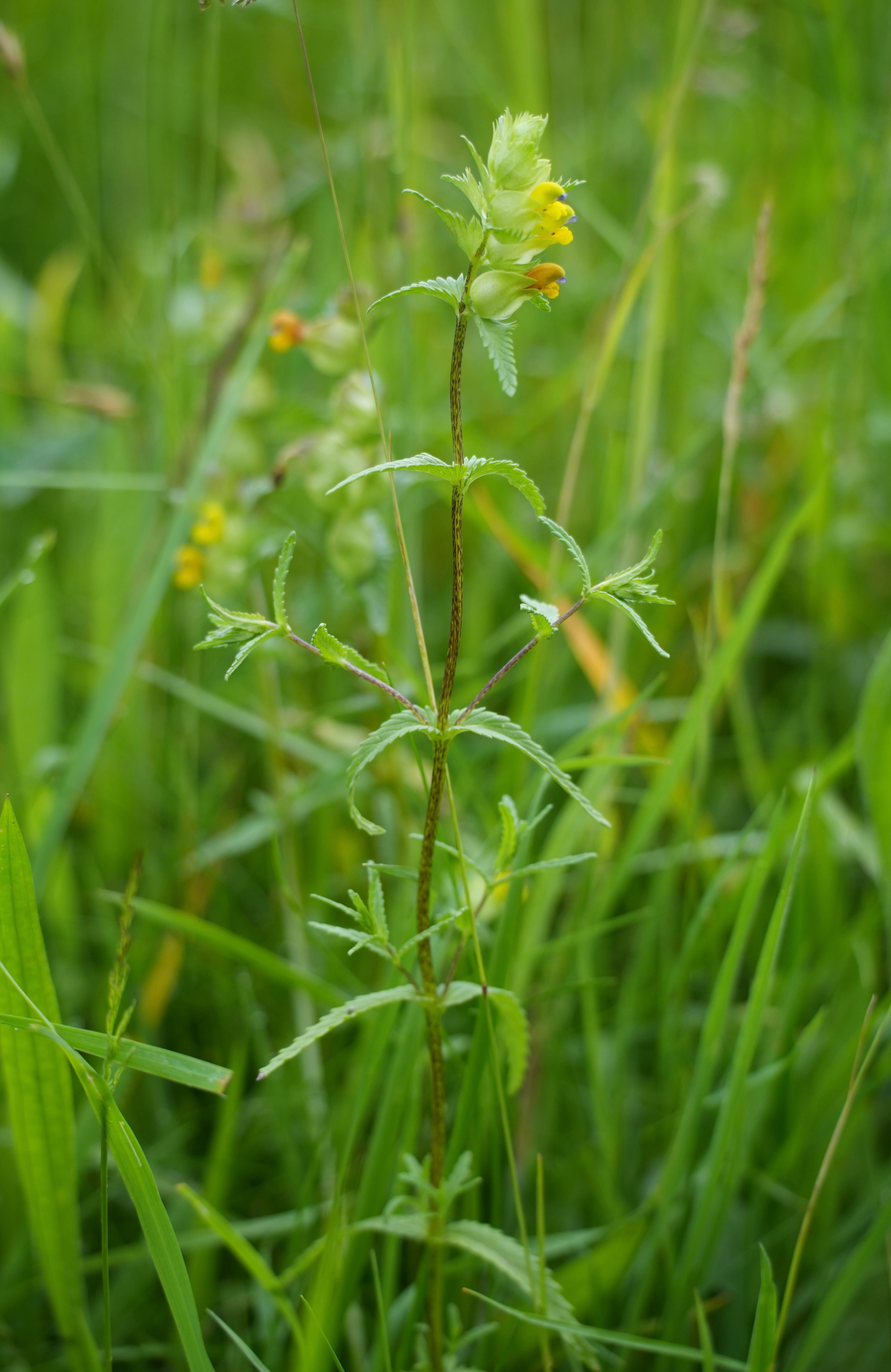
Yellow rattle. It’s yellow and yes, its seed pods rattle - quite loudly in fact!
We mainly talk about Yellow rattle, Rhinanthus minor, in a utilitarian manner. The main reason people want it in grasslands is to keep the vigour of strong wild grasses like cock’s foot under control. It does this by attaching its roots to those of grasses and other plants, extracting nutrition weakening those other plants. Very useful indeed.
In our meadow I see this first-hand, as the above photo shows, where yellow rattle grows, it parasitises the grasses and reduces their height. The effect is doubly powerful with its partner in crime, Eyebright, which is much less talked about.
Rhinanthus minor originates from all across Europe, Western Russia and the middle east. It requires full sun to grow and is an annual.
Yellow rattle seedlings emerge around mid-spring with distinctive pale green ribbed leaves. Usually in clusters. I can’t think of any meadow plant that really looks like it, making it easy to identify.
How to grow and establish yellow rattle
The only information you need to know about establishing yellow rattle is that it’s an annual, it needs full sun and the seeds need winter cold in order to germinate well. The process of stratification, where the cold and wet of winter breaks the coating of the seed and tells the embryo to grow as weather warms and days lengthen in spring.
The embryo in the seed also doesn’t last long, it usually has to grow within the first year. For all of these reasons the essential step is to sow the seeds fresh, around the time they drop in the wild.
If you have permission from the land owner (very important to not affect an existing ecosystem) collecting yellow rattle seed is easy. The large seed pods turn dry and brown with the seeds clearly visible inside.
Naturally the pods would wave around in the wind or when knocked by an animal, releasing the large and fairly heavy papery seeds around the plants. While the seeds may travel a little way from the parent plant, they are too heavy to blow far on the wind and the plants too short. Seeds are generally scattered closely to the parent plant. Unless cut and mixed into a hay collection or eaten and spread by herbivores.
I collect some seed, tipping into my hand, from the bottom of our meadow where we have lots of yellow rattle and take them up to the top where there is very little. Rather than save the seed, I just scatter it about immediately where I’d like it to grow.
By doing this last autumn, I have managed to start new colonies at the top of the meadow where there was no yellow rattle before and the grasses were long. In these patches the grass is already shorter.
Is yellow rattle good for wildlife?
Yes, on top of yellow rattle’s ability to make meadows more biodiverse plant wise, helping more insects and birds, it directly helps lots of wildlife.
Bumblebees, solitary bees and hoverflies all feed on its nectar. Birds and mammals will eat the large seeds in summer.
Wild Way Live!
Join me at 6pm on Tuesday 7th July for the next Wild Way workshop (for paid subscribers with a £26/yr subscription). This time it will be on Substack live, which is best accessed through the app or on a desktop browser. I'll recap on some of the recent topics, look at late-summer plants and answer your questions.
Further reading
Please check out my monthly back page column in Gardens Illustrated magazine, this month’s explores research into biodiversity in gardens being linked to our mental health. I also have an article about feeding birds naturally in The Simple Things magazine.
The Great British Gardening Festival? We should aim higher than Chelsea Flower Show (Gardens Illustrated)
What can be done about problematic invasive plants? (Slow the Flow)
Keep learning with a Wild Way £26/yr paid subscription
10 plants that bring order to an unkempt garden
Our garden is so exciting this year and it’s amazing how much it has changed since the alliums only a month ago! But I am aware it can veer into unkempt mess. Which is why I keep a few planty tricks up my sleeves and I’ll reveal some to you below…
Centaurea nigra | knapweed
Six spot burnet moth, Zygaena filipendulae, on Knapweed, Centaurea nigra - two of my favourite things. Knapweed is hands down one of my top plants of all time. Easy to grow, flowers for ages and supports a huge number of beautiful flying insects. What’s not to love?
Midsummer gardening
Solstice, on 21st June, is the scientific term for when one of the hemispheres of Earth is most inclined toward the sun on the planet’s orbit.
Stachys sylvatica | hedge woundwort
In the first spring of moving to Yorkshire, I noticed a beautiful plant in the herb bed outside the house. Having never set eyes on it before, I assumed this rich purple flower must be an ornamental lamium, herb or salvia that had been planted by a previous owner. When I asked on social media what it was, everyone laughed and pointed out that, not only is it a wildflower, it’s considered a weed, and I really should have known better.


