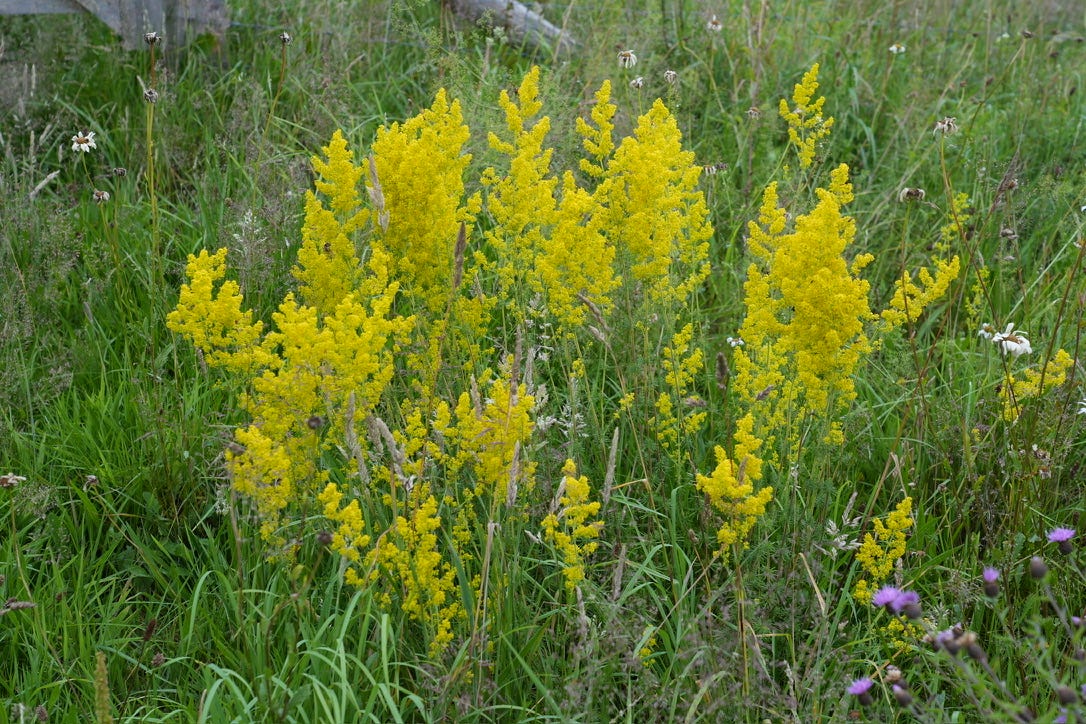
I have an absolute obsession at the moment with our native wildflower, Galium verum, commonly known as Lady’s Bedstraw. I’ve walked past it at the bottom of our garden and loved if for the last five years but this year I’m obsessed.
I suppose it started thinking about the moth caterpillars that feed on it, our 2 - 3 plants are supporting a lot of wildlife. I decided to propagate more plants from their seeds and rooted stolons to increase the population making it less fragile.
Then it dawned on me that it’s such a stylish plant. That floofy yellow is exactly the same yellow everyone is falling over themselves to grow in gardens at the moment from cultivated flowers such as giant fennel and verbascums. Yet here it is, a pale summer yellow right in front of us on one of the toughest grassland wildflowers.
Need to know information about Galium verum
Native to temperate Eurasia and northern Africa, Lady’s Bedstraw has one of the largest ranges of wildflowers we’ve been discussing on Wild Way. Demonstrating how broad its tolerance is of different growing conditions. Which makes it all the more bonkers to look to gravel or sand planting in the UK for similar plants before even considering the wildflowers under our noses. This is another brilliant climate change resilient plant in regular soils.
It flowers from mid-summer until late-summer, a good long period of time. Reaching about 60cm or so high by the same wide. In early summer it emerges in a mound of attractive fine leaves growing in whorls around the stems.
Lady’s bedstraw needs full sunlight and grows well in low grassland. If it becomes shaded by taller grasses or other plants it will dwindle. On our farm it is growing in semi-rough but low grassland among other wildflowers. I don’t tend to cut this area and the wildflowers grow strongest here.
The name bedstraw is thought to come from the plant’s use for stuffing mattresses back in the day. The flowers smell sweetly of honey in warm summer sun.
Using lady’s bedstraw in garden design
Lemon or primrose yellow flowers against vibrant green stems creates a fresh and contemporary look at a point in midsummer that needs it. Lady’s bedstraw grows in vertical to fountain shaped plumes of tiny flowers from June to September.
It partners well with all wildflowers, especially other late season flowers such as complementary white and yellow ox-eye daisy and contrasting purple knapweed, pink musk mallow or pale-blue devil’s-bit scabious. Including it in a mix of full-sun plants such as these or similar, they balance into a stable plant community (show in these photos).
On top of growing lady’s bedstraw in full or mini meadows, it works well in a regular planting scheme as you would other airy lemon yellow plants. I plan to introduce it to our main garden.
This sort of yellow works well as a modern seam of colour in a garden, such as a calm scheme with white flowers. Partnered with red or purple creates a likely and striking contrast. While alongside the blue of Devil’s-bit scabious or Field scabious makes for a softer palette. I really love it with the dark purple of knapweed, they set each other off.
You could have one clump but I always think this shade of yellow works best dotted around the garden or in repeated sweeps. Adding an electric acid yellow-green that enlivens everything else.
How to propagate lady’s bedstraw?
Galium verum produces stolons, above ground horizontal shoots that stretch away from the main plant and root next to it, forming a new plant. This is exactly the same as with strawberries.
Digging up these rooted plants in late summer or autumn (from a garden, not the wild, that is illegal) is the easiest way of propagating them. Alternatively, you can grow them from seed.
I’ve collected lots of seeds from one of our plants this year, the little round black seeds are less than half a millimetre in size. Sow these onto the surface of peat free compost in autumn or spring, water and wait for them to germinate.
Once you have some small plants, they can be planted wherever you want them and they should grow away strongly as long as they are in full sun.
Is lady’s bedstraw good for wildlife?
Lots of pollinators will feed on Galium verum for pollen and nectar - ours are always covered in meadow brown butterflies, small skippers and day flying moths. In addition, moth caterpillars feed on the leaves including bedstraw hawkmoth (Hyles gallii), elephant hawkmoth (Deilephila elpenor) and small elephant hawkmoth (Deilephila porcellus). Even one of my favourites, the hummingbird hawkmoth (Macroglossum stellatarum) caterpillars feed on it if they can survive the UK’s winters.
Is lady’s bedstraw edible?
Yes, the young stems and leaves can be eaten raw or cooked like spinach.
Stay tuned as I propagate our plants and introduce them to new areas around our farm in 2026.
Keep learning with the Wild Way...
Wild Plant A-Z
Wildflowers and other wild plants without woody stems that either grow and dieback in winter or are evergreen. Herbaceous wildflowers are colourful resilient plants. Wildflower database »
How to establish permanent wildflower plantings
You don’t need a meadow to grow wildflowers, I dot them in our garden borders among cultivated plants. By their nature, most wildflowers are easy plants - they grow where they grow because they like and evolved in exactly those conditions. Once established, they tend to look after themselves but establishing wildflowers in the first place isn’t always straightforward. Here I’ll share some tips and tricks I’ve learnt over the years for starting wildflowers in your garden.
Sow and grow annual onions and shallots from seed
I always sow our brown and red onions, as well as shallots, from seed shortly after the winter solstice to coincide with lengthening days. If you haven’t grown them from seed before, it can be hard to believe they’ll grow into fully harvestable vegetables by summer, but I promise you they will! Once you grow onions and shallots from seed, you will never go back to expensive onion sets (heat treated baby onion bulbs).


Lovely piece about a wonderful plant thank you
North American readers should be aware that this plant is highly invasive